
A potage crème built on a classic Escoffier formula 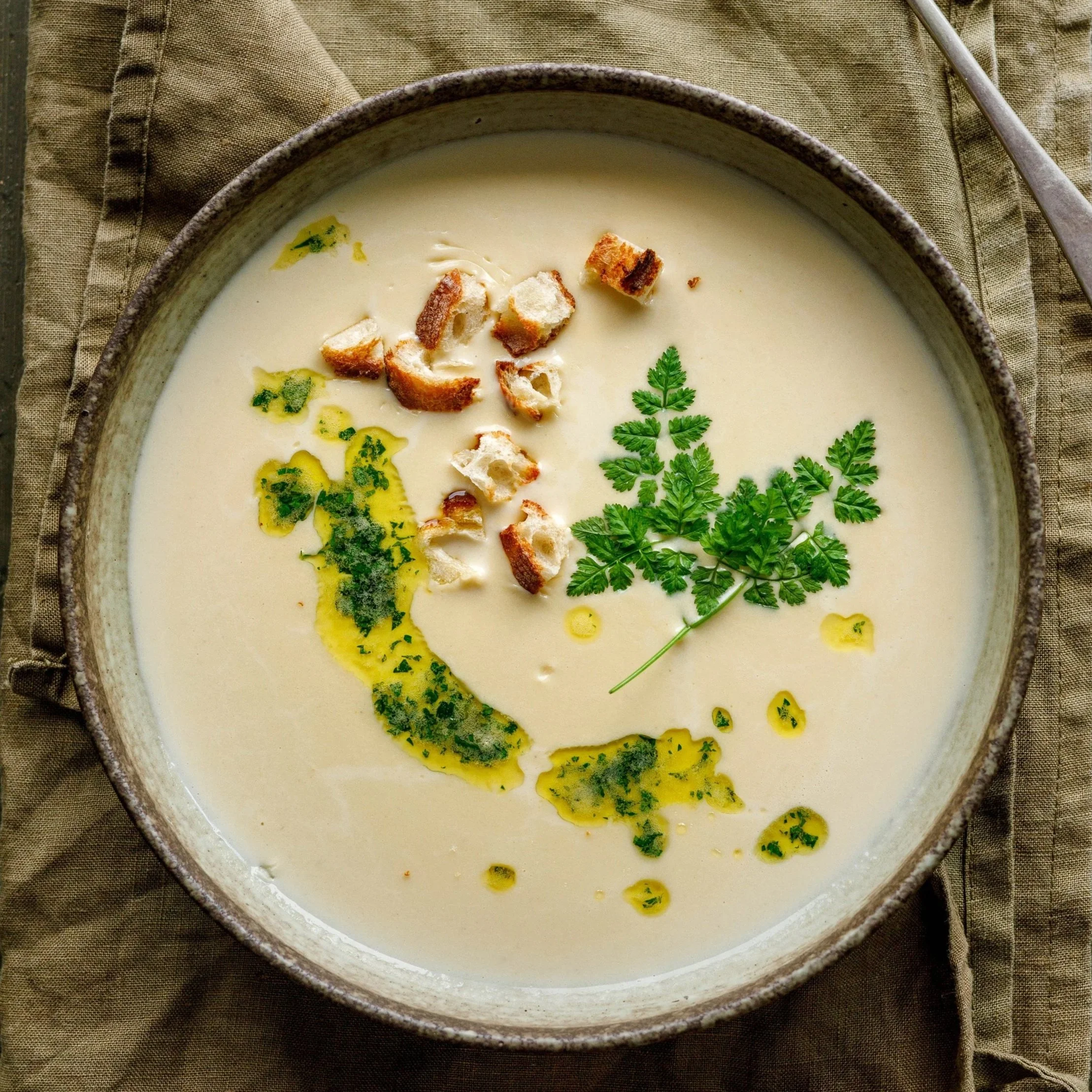
The Potage Soissonnais, or cream of white bean , tells you a story. Soissons is a town in the north of France, east of Paris, long known for its large white haricot beans, and in classical French cooking any dish called soissonnais or à la soissonnaise is made with white beans. This soup is a potage crème, one of the cream soups Escoffier built on a clear formula: roughly half thin béchamel, a quarter vegetable purée, and a quarter broth and cream to finish. Once you understand that structure, you can apply it to many other vegetables, from mushrooms to asparagus. Here the beans bring a gentle, earthy flavour, and the straining is what turns a rustic bean soup into something smooth and velvety you would be proud to serve at a dinner party. It’s a rich soup, so small bowls are all you need.
Serves 4 (about 1 litre / 4 cups)
Prep time: 20 minutes, plus cooking the beans
Cook time: 25 minutes
INGREDIENTS
White Bean Purée
250 g (9 oz) cooked white beans (see Mise en Place)
50–100 ml warm bean cooking broth
Thin Béchamel
600 ml (2½ cups) whole milk
½ small onion, sliced
1 small piece carrot
1 small piece celery stalk
1 small piece leek
A few fresh parsley stalks
1 sprig thyme
1 bay leaf
2–3 whole cloves
Pinch of salt
Freshly ground white pepper
12.5 g (1 tbsp) unsalted butter
12.5 g (1½ tbsp) all-purpose flour
To Adjust Consistency
100 ml (scant ½ cup) warm bean cooking broth
150 ml (scant ⅔ cup) heavy cream
Salt and freshly ground white pepper
To Garnish (optional)
Croutons, fried in butter or toasted
30 g (2 tbsp) unsalted butter, melted
1 tbsp finely chopped fresh parsley and chervil
Small pinch of finely chopped garlic
Small pinch of salt
MISE EN PLACE
To purée the beans, a stick (immersion) blender or bench (countertop) blender is the most practical option for a home kitchen. You will also need a chinois or fine-mesh sieve for removing the skins and straining the soup.
The beans need to be cooked ahead. Simmer them in beef or vegetable stock with a carrot, an onion studded with the cloves and a bay leaf until completely tender, then keep them in their cooking broth. You will need at least 200 ml (scant 1 cup) of that broth for this recipe, so don’t throw it away.
If using croutons, prepare them before you start.
METHOD
Start with the purée. Lift the beans out of their cooking broth and remove all the aromatic garnish (the carrot, the onion studded with cloves and the bay leaf), so only the beans go into the purée. Warm the beans gently in a small saucepan and blend them with a stick blender or in a bench blender, then push the purée through a fine-mesh sieve to remove the skins. Loosen it with 50 ml of the warm bean broth, adding a little more if needed, until you have a smooth, thick purée. Weigh out 250 g (1 cup) and set it aside.
Next, infuse the milk. In a medium saucepan, combine the milk with the onion, carrot, celery, leek, parsley stalks, thyme, bay leaf and cloves, and season with a pinch of salt and some white pepper. Heat gently over medium-low heat until the milk is hot and fragrant, without letting it boil. Turn off the heat and leave the aromatics to keep infusing while you make the roux.
In a separate saucepan, melt the butter over medium-low heat, add the flour all at once and stir with a wooden spoon into a paste. Cook for 2 minutes without letting it take on any colour. This is your white roux. Remove it from the heat and let it cool slightly.
Strain half of the hot milk through a fine sieve over the roux and, off the heat, whisk until smooth and free of lumps. Strain in the rest of the milk and whisk again. Return the saucepan to medium heat and bring it to a gentle boil, whisking constantly, until the béchamel starts to thicken. Lower the heat and simmer gently for 3 minutes, stirring all the time with a wooden spoon. Don’t expect a thick sauce here. A thin béchamel stays quite fluid, and that is exactly what you want.
Now whisk the bean purée into the hot béchamel and let it simmer over low heat for 3 to 5 minutes so the flavours come together. Pass the soup through a chinois or fine-mesh sieve into a clean saucepan, pressing with the back of a ladle to extract as much as you can, and discard any grainy solids left behind. Don’t skip this step. It is what gives a crème its texture.
Return the soup to low heat. Stir in the 100 ml of bean broth to bring back the flavour and body of the beans, followed by the cream. Let it simmer gently on the lowest heat for about 5 minutes, then taste and adjust the seasoning with salt and white pepper. For a perfectly smooth, glossy finish, pass the soup through a fine sieve one last time into your serving pot. It’s an extra step, but this is how it would be done in a classical kitchen.
To serve, mix the melted butter with the chopped herbs, garlic and a small pinch of salt. Ladle the soup into warm bowls, float a few croutons on top and drizzle a little of the herb butter over the surface.
Cooking Notes
The béchamel for a cream soup is intentionally thin. If you make it to the consistency of a sauce béchamel, the soup will turn heavy and pasty once the purée goes in.
The soup thickens as it stands. When reheating, loosen it with a little bean broth rather than more cream so the bean flavour stays at the front.