
watercress butter sauce
A watercress sauce that will elevate any chicken breast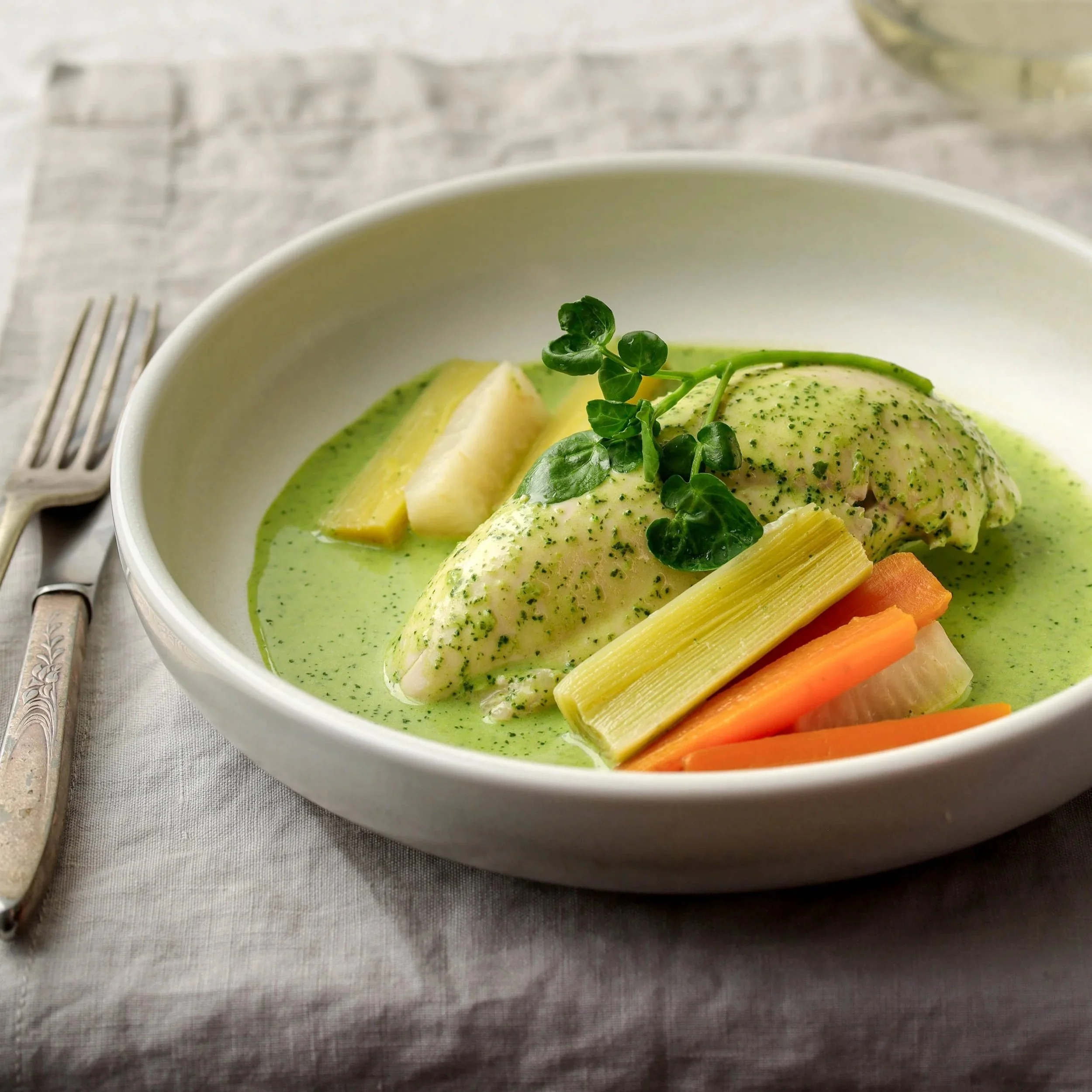
This recipe comes from the repertoire of Frédy Girardet, the legendary Swiss chef from near Geneva who was considered one of the finest in Europe. A friend once told me that Girardet was an absolute magician when it came to pairing ingredients. He had this remarkable ability to take what seemed like random components and turn them into something extraordinary. So, naturally, I was very curious to try one of his recipes.
What I love about this dish is its elegant simplicity. The chicken is gently poached in stock using the French method of cooking by concentration - starting in boiling liquid to seal in flavour and moisture. The sauce is made from the reduced cooking broth, a touch of cream, and a vibrant watercress compound butter that brings a beautiful garden-fresh flavour to the plate. It’s the kind of recipe where every element has a purpose, and the result is far greater than the sum of its parts.
Served with an array of poached vegetables, this is comfort cooking at its most refined - simple technique, honest ingredients, and a sauce that will have you reaching for seconds.
INGREDIENTS
Serves: 4
For the Watercress Butter
100 g (3½ oz) fresh watercress leaves, picked and washed
100 g (3½ oz) unsalted butter, softened
For the Poached Chicken
1 whole chicken, approximately 1.6 kg (3½ lb), trussed
1.5 L (6¼ cups) white chicken stock, homemade or store-bought
1 onion, halved
10 cm piece of leek (green part), trimmed and washed
½ celery rib (optional)
1 bouquet garni (bay leaf, thyme, parsley stalks)
Salt to season
Vegetable Garnish for 4 People (as per the original recipe)
8 spring carrots, peeled and cut into large chunks
3 small leeks, trimmed and cut into 5 cm sections
2 small celeriac, peeled and cut into wedges or batons
12 small new potatoes, peeled and quartered
8 baby turnips, peeled and quartered
For the Sauce
300 ml (1¼ cups) poaching broth (reserved from cooking)
120 ml (½ cup) heavy cream
60–80 g (2–3 oz) watercress butter (prepared above)
MISE EN PLACE
You will need a large, deep saucepan or stockpot (at least 26 cm/10 inches) that can comfortably fit the chicken with enough room for the stock to cover it. A food processor with a small bowl attachment is ideal for making the watercress butter.
Make the watercress butter in advance and refrigerate until firm. To do this, pick and wash the watercress leaves, wash and drain well and pat dry. Process the leaves in a food processor until they form a wet paste, this may take a few rounds of processing, scraping down the sides each time. Add the softened butter in three additions, processing between each until fully combined. The mixture should be a vibrant green. Shape the butter into a log using cling film and refrigerate until needed.
Peel, wash and prepare all your vegetables you want to use before you begin poaching the chicken.
Method
Poaching the Chicken
Begin by bringing the stock to a full boil in your stockpot. Add the aromatic garnish, the onion, leek and bouquet garni - along with a teaspoon or two of coarse salt. Carefully lower the trussed chicken into the boiling stock. The idea here is to start the chicken in hot liquid, which firms up the flesh on contact (much like searing a steak) and helps keep the flavour and moisture inside the bird rather than leaching out into the broth.
Once the chicken is in, reduce the heat to a gentle simmer. If your chicken sticks out above the liquid, lay a piece of leek over the exposed area as a little blanket to prevent drying. Top up with a bit more broth if you have it. Partly cover the pot with a lid to maximise heat retention.
While the chicken is cooking, boil the vegetables you have chosen in salty water until tender. You can cook the celeriac and turnip together, but cook the rest separately.
Poach for 40 minutes at a steady simmer. When the time is up, first discard the aromatic garnish - the bouquet garni, onions and the large piece of leek - then transfer the chicken to a separate pan with a ladleful of broth to keep it warm. Leave the chicken with the heat off and a lid on to stay warm and rest while you prepare the sauce.
To Make the Sauce
Scoop out approximately 300 ml (1¼ cups) of the poaching broth and pass it through a fine-mesh sieve into a clean saucepan. Over high heat, reduce this broth by roughly two-thirds - you want an intensely flavoured, concentrated base of around 100–120 ml. Don’t hesitate to keep the heat high here; it will save you time and help develop a deep, pronounced chicken flavour.
Pour in the cream and continue to reduce by half, or until the sauce reaches a semi-thick consistency. Now, incorporate the watercress butter a little at a time, stirring continuously over a brisk heat. Girardet calls for all the butter, but you may wish to add it gradually and taste as you go - start with around 60 grams and adjust. The sauce should be hot, but take care not to bring it to a full boil, as this can split the butter emulsion. When the sauce coats the back of a spoon, it is ready. Remove from the heat.
To serve, carve the chicken into portions. For poached chicken, I prefer to remove the skin, as it can have a slightly unappealing texture when not roasted. Arrange the chicken on a serving dish or individual plates, spoon the watercress cream sauce generously over the top, then surround with the warm poached vegetables.
TIPS
If you like, you can, like me, cook the vegetables in the broth with the chicken, but you will need a pot with enough space and stock to do that. Otherwise cook them individually as instructed in the recipe.
Don’t discard the remaining poaching broth - it makes a beautifully flavoured chicken bouillon that can be used as a base for soups, risottos or a standalone sauce.
Finding the right-sized pot is key. A 26 cm deep saucepan works well for a standard chicken, keeping the amount of stock manageable. If your pot is too large, you’ll need significantly more stock to cover the bird.